
A dental crown is often much more than a simple cosmetic fix; it serves as a structural helmet that protects a compromised tooth from a catastrophic break. You might find yourself wondering exactly when is a crown necessary and if a standard filling could do the job just as well. It's completely normal to feel a bit of hesitation when your dentist suggests a treatment that feels more involved than a routine cleaning, especially when you're balancing concerns about costs and the longevity of your dental work.
We believe you deserve to feel like an empowered partner in your health journey. You likely want to preserve your natural smile while avoiding the stress of more invasive procedures down the road. In this article, you'll discover the specific clinical signs that indicate a restoration is the right choice for your long-term health. We'll also explore how modern materials like zirconia and lithium disilicate provide a durable, natural look that helps you eat and smile with total confidence. By understanding the risks of delay and the benefits of proactive care, you can make the best decision for your unique smile.
Key Takeaways
- Learn how a custom-fitted crown acts as a protective shield to restore the function and beauty of a tooth that is too damaged for a simple filling.
- Identify the specific clinical signs, such as extensive decay or deep fractures, that help determine when is a crown necessary to save your natural smile.
- Understand why delaying treatment can lead to more complex issues, like vertical fractures that might make a tooth impossible to save.
- Discover the gentle, step-by-step process of preparing a tooth for a custom-fitted crown that blends seamlessly with your surrounding teeth.
- Explore how a compassionate, patient-centered approach in Rancho Cucamonga prioritizes your comfort while focusing on preserving your natural teeth.
What is a Dental Crown and Why is it Used?
A dental crown is a custom-fitted restoration that we often describe as a protective helmet for your tooth. Unlike a filling that sits inside a cavity, a crown fully encases the visible portion of your tooth above the gumline. To understand What is a Dental Crown, it's helpful to view it as a structural "cap" designed to restore a tooth's original shape, size, and strength. Our primary goal is always tooth preservation; we want to keep your natural smile intact for as long as possible while ensuring you can chew and speak without discomfort.
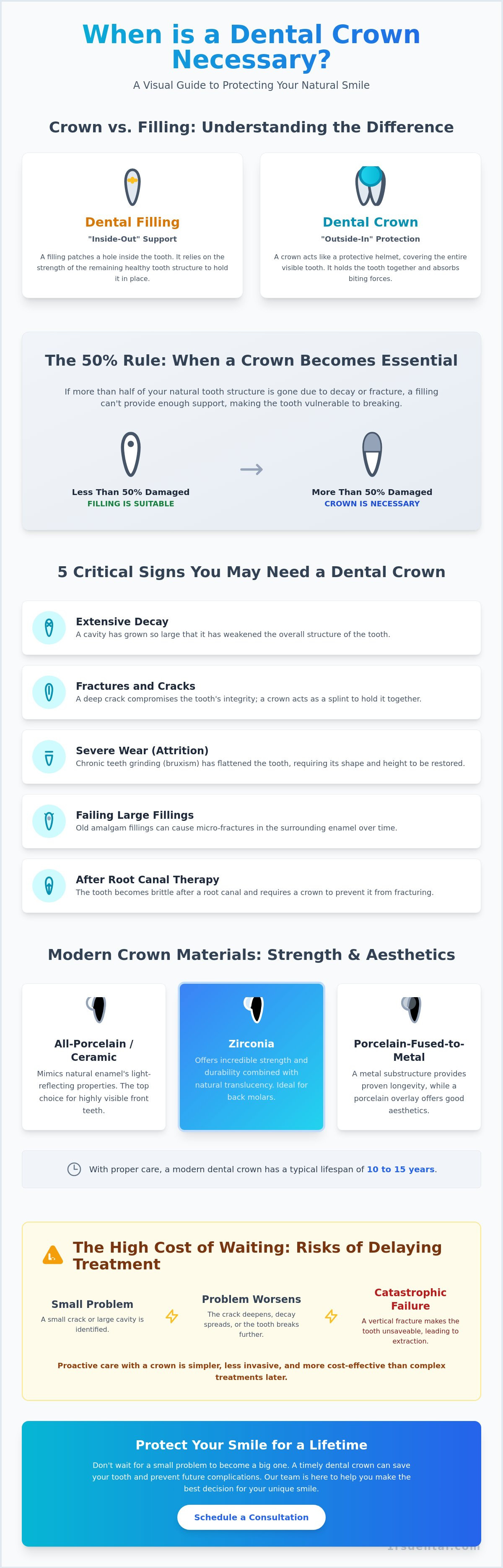
When we discuss your treatment plan, we focus on the difference between "inside-out" support and "outside-in" protection. A composite filling provides support from the inside, but it relies on the surrounding natural enamel to stay strong. In contrast, a crown provides "outside-in" protection by shielding the entire structure from biting forces. Understanding when is a crown necessary is a vital part of your health journey, as it helps you decide how to best protect your smile from future fractures or deep decay.
The Difference Between a Filling and a Crown
Many patients feel confused about why a simple filling isn't always enough. A helpful way to look at it is the "filling-to-tooth ratio." If decay or a chip has compromised more than 50% of your natural tooth structure, the remaining enamel becomes thin and brittle. Think of it like patching a small hole in a wall versus reinforcing the entire foundation of a building. A standard filling might stay in place, but it can't prevent the weakened walls of the tooth from cracking under pressure. By choosing a crown in these situations, you're investing in a long-term solution that distributes biting pressure evenly, which significantly reduces the risk of the tooth splitting.
Common Materials: From Porcelain to Zirconia
Modern dentistry offers incredible materials that blend durability with a natural appearance. For teeth in your "smile zone," we often recommend all-ceramic or porcelain crowns because they mimic the light-reflecting qualities of natural enamel beautifully. If you need a restoration for a back molar that handles heavy chewing, Zirconia is an excellent choice. It's known for its incredible strength and natural translucency. We also use porcelain-fused-to-metal (PFM) when we need a balance of aesthetic appeal and the proven longevity of a metal substructure. With proper care, these restorations typically have a lifespan of 10 to 15 years, providing you with a functional and confident smile for a decade or more.
5 Critical Signs a Dental Crown is Necessary
Identifying the right moment for a restoration can feel uncertain, but your teeth often provide clear physical cues when they need extra support. Understanding when is a crown necessary usually involves looking at the structural integrity of the enamel. If a tooth can no longer support itself under the daily pressure of chewing, a protective cap becomes the most reliable way to prevent a total break. Here are five specific situations where we typically recommend this treatment:
- Extensive Decay: When a cavity consumes more than 50% of the natural tooth structure, a standard filling lacks the surface area needed to bond securely.
- Fractures and Cracks: If a tooth has a deep crack that extends toward the root, a crown holds the pieces together like a sturdy splint.
- Severe Attrition: Long-term teeth grinding, or bruxism, can flatten the biting surface, leading to sensitivity and a collapsed bite that requires height restoration.
- Large Silver Fillings: Old amalgam restorations expand and contract with temperature changes over time, often creating "stress lines" or micro-fractures in the surrounding enamel.
- Post-Root Canal Care: Once the internal pulp is removed, the tooth loses its nutrient supply and becomes significantly more brittle.
If you've noticed a nagging ache when you bite down or a visible chip that feels sharp to your tongue, it may be time to evaluate your options. Our team is here to help you navigate these choices with personalized Dental Crowns and Bridges that prioritize both your comfort and your long-term oral health.
Protecting a Tooth After Root Canal Therapy
A common question we hear is why a crown is needed after a root canal has already fixed the pain. During root canal therapy, we remove the infected pulp, which contains the blood vessels that keep the tooth hydrated. Without this "living" center, the tooth becomes like a dry branch; it's still functional, but it's much more likely to shatter under pressure. We view the crown as the essential final step of the procedure. It provides a hermetic seal that prevents bacteria from re-entering the canals while giving the tooth the physical strength it needs to last for decades. You can learn more about the specifics of The Dental Crown Procedure to see how this seal is achieved.
Restoring Large Cavities and Broken Enamel
When a tooth is compromised by a large cavity or "Cracked Tooth Syndrome," the pain often occurs specifically when you release your bite. This happens because the segments of the tooth are flexing apart. A crown solves this by distributing biting pressure evenly across the entire surface of the tooth rather than letting the force concentrate on a weak point. Beyond the functional relief, there's a significant aesthetic benefit. We carefully sculpt each restoration to match your natural tooth's contour and shade, ensuring your smile looks as healthy as it feels. This collaborative approach ensures you feel confident in your treatment plan and the longevity of your results.
The Risks of Delaying Treatment: Why 'Waiting' Can Be Costly
It's natural to believe that if a tooth doesn't hurt, it doesn't need immediate attention. In restorative dentistry, however, pain is often a late warning sign rather than an early one. By the time you feel a dull ache or a sharp "zing" while eating, the internal damage may already be extensive. Determining when is a crown necessary often comes down to timing; acting before the tooth structure fails completely is the key to a predictable and comfortable outcome. One of the primary benefits of a dental crown is its ability to stop damage in its tracks, protecting the sensitive nerve inside from exposure.
If you choose to delay treatment, a small hairline crack can easily evolve into a vertical fracture. This type of break often travels deep below the gumline, which typically makes the tooth non-restorable. In these unfortunate cases, we have to move from saving the tooth with a crown to performing a Tooth Extraction. Cracks also act as microscopic doorways for bacteria. Once these germs reach the soft pulp, an abscess can form, requiring Root Canal Therapy in addition to the crown you originally needed. Proactive care is almost always more cost-effective and less invasive than waiting for a crisis to emerge. Choosing a restoration early prevents the need for a Dental Bridge or an implant to fill a gap left by a lost tooth.
Preventing Catastrophic Tooth Failure
The human jaw is incredibly powerful, capable of exerting biting forces up to 200 pounds on the back molars. When a tooth is already weakened by a chip or a large filling, these daily forces act like a wedge, slowly widening any existing structural flaws. Losing even one tooth can trigger a "domino effect" where your remaining teeth shift out of place to fill the gap. This shift often leads to bite alignment issues and unnecessary jaw strain. We view a crown as a proactive investment in your health, stabilizing your bite and ensuring your natural teeth stay exactly where they belong.
When a Crown Becomes an Emergency
There are certain physical signs that indicate you can no longer wait for a planned appointment. If you experience persistent swelling in the gums, sharp pain when releasing a bite, or if a visible piece of enamel has broken off, you should seek a clinical evaluation immediately. Emergency dental visits are often more stressful and rushed than scheduled restorative care. To help you maintain a calm and steady health journey, we offer urgent restorative assessments at our Rancho Cucamonga office. Understanding when is a crown necessary before an emergency occurs allows you to choose your treatment path with total confidence and peace of mind.
What to Expect: The Dental Crown Procedure Step-by-Step
Understanding the steps of a dental restoration can transform a source of uncertainty into a clear path toward a healthier smile. Once our clinical team determines when is a crown necessary for your specific situation, the restoration process typically unfolds over two comfortable visits. This methodical approach ensures that your new crown fits perfectly and functions just like a natural tooth.
The journey begins with a thorough initial assessment. We utilize digital X-rays to evaluate the health of the tooth's roots and the surrounding bone structure. This step is vital because it confirms the foundation is strong enough to support the new restoration. After the assessment, the procedure follows a precise sequence:
- Preparing the Tooth: We gently remove any existing decay or old filling material. The enamel is then carefully shaped to create a stable base for the crown to rest upon.
- Capturing the Impression: We take a highly accurate impression of your prepared tooth. This serves as the blueprint for the dental lab to craft a crown that matches the exact dimensions of your bite.
- The Temporary Crown: While your permanent restoration is being meticulously created, we place a temporary crown. This protects the sensitive tooth structure and maintains your smile's appearance in the interim.
- Final Placement: During your second visit, we remove the temporary and bond the permanent crown in place. We pay close attention to the seamless aesthetic match, ensuring the color and shape blend in perfectly with your surrounding teeth.
While we have already explored when is a crown necessary to prevent catastrophic fractures, the procedure itself is designed to be a gentle, restorative experience. If you are ready to restore your smile’s strength, we invite you to schedule an assessment for Dental Crowns and Bridges with our compassionate team.
Ensuring Your Comfort During the Visit
Your peace of mind is our highest priority throughout the entire process. We begin with a localized anesthesia to ensure the area is completely numb, making the preparation phase entirely painless. Our team maintains a calm, steady communication rhythm, explaining each step before it happens to help diminish any dental anxiety. During the final fitting, we perform a precise bite adjustment. This ensures that your upper and lower teeth meet comfortably, which prevents jaw strain and ensures the longevity of your new restoration.
Caring for Your New Crown
A well-crafted crown is a long-term investment in your health, and simple daily habits will keep it in excellent condition. You should brush and floss just as you do with your natural teeth, paying special attention to the margin where the crown meets the gumline. For the first 24 hours after final placement, it’s best to avoid extremely sticky or hard foods to allow the dental cement to set completely. Regular check-ups remain essential, as they allow us to monitor the seal of the crown and ensure your gums stay healthy and vibrant around the restoration.
Restorative Excellence at U-First Dental Care in Rancho Cucamonga
At U-First Dental Care, we believe that every patient deserves a treatment plan built on mutual trust and clinical excellence. Dr. Magaly Velasquez leads our practice with a philosophy of "compassionate expertise," ensuring that your comfort is just as important as the precision of your dental work. Our core mission is the preservation of your natural smile. We focus on saving your teeth whenever possible, utilizing advanced Dental Crowns and Bridges or Root Canal Therapy to restore strength and function. Our team proudly serves neighbors throughout Rancho Cucamonga, Ontario, Upland, and Alta Loma, providing a stable and reliable presence for your family’s oral health.
We understand that dental visits can sometimes feel overwhelming, which is why we prioritize a transparent and high-pressure-free environment. We don't use urgent marketing tactics or complex clinical jargon to rush your decisions. Instead, we speak to you as an equal partner. Determining when is a crown necessary is a collaborative process where we present the clinical facts and allow you to choose the path that fits your life. This methodical and supportive approach ensures you feel heard and respected from the moment you walk into our office.
A Personalized Approach to Your Smile
We recognize that no two smiles are identical. This is why we customize crown materials to match your specific aesthetic and functional needs. If you need to restore a back molar that handles heavy biting pressure, we might suggest high-strength zirconia. For teeth in your "smile zone," we often favor all-ceramic materials for their natural beauty. We want your restoration to feel like a seamless part of your body. Our office provides a neighborly hospitality that aims to diminish the typical anxieties associated with medical environments. You can expect a steady, calm rhythm during your visit that respects your time and your peace of mind.
Schedule Your Consultation Today
If you've been living with a chipped tooth or are worried about an old, large filling failing, our team is here to provide clarity. We treat every individual with the personalized attention and deep respect they deserve. We value long-term relationships over simple transactions, and we look forward to being your guide on this health journey. For residents across the Inland Empire, a healthier and more confident smile is within reach. Schedule your restorative consultation at U-First Dental Care today to discover how we can help you protect your natural smile for years to come.
Protect Your Smile with Confidence
Choosing a dental restoration is a proactive step toward maintaining your oral health for years to come. You've learned how a custom crown provides essential structural support and why acting before pain begins can save you from more complex treatments like tooth extractions. Understanding exactly when is a crown necessary allows you to move forward with a plan that prioritizes your comfort and long-term functional needs.
Led by Dr. Magaly Velasquez, DDS, our practice has served neighbors in Rancho Cucamonga, Ontario, and Upland for years. We specialize in Root Canal Therapy and high-quality restorations that look and feel completely natural. We invite you to Book Your Dental Crown Consultation in Rancho Cucamonga to receive a personalized assessment in a warm, welcoming environment. Your health journey is a partnership, and we're here to support you every step of the way.
Frequently Asked Questions
Can a crown be put on a tooth with a large cavity?
Yes, a crown is often the most reliable solution for a tooth with an extensive cavity that a standard filling cannot support. When decay removes a significant portion of the enamel, the remaining structure becomes too weak to withstand the pressure of chewing. By encasing the tooth, a crown provides the necessary structural integrity to prevent future fractures and save your natural smile.
How long does a dental crown typically last?
A dental crown typically lasts between 10 and 15 years, though many can last much longer with excellent home care. The longevity of your restoration depends on the material chosen and your commitment to daily brushing and flossing. We monitor the condition of your crown during regular dental cleanings to ensure the seal remains intact and the underlying tooth stays healthy.
Is it possible to get a crown without a root canal?
It is absolutely possible to receive a crown without undergoing root canal therapy first. We only recommend a root canal if the internal pulp of your tooth is infected or damaged. In many cases, we determine that a crown is necessary simply to protect a tooth from breaking or to replace a failing filling while the healthy nerve remains completely undisturbed.
Does it hurt to get a dental crown?
The process of receiving a dental crown is designed to be a comfortable and painless experience. We use local anesthesia to thoroughly numb the tooth and the surrounding gums before we begin any preparation. While you might feel some minor pressure during the visit, our gentle and methodical approach ensures that the sensation is very similar to receiving a routine composite filling.
What happens if a crown falls off?
If your crown falls off, you should contact our office immediately to schedule a restorative assessment. Please keep the crown in a safe container, as we can often clean and re-bond it if the underlying tooth structure is still healthy and stable. You should avoid using over-the-counter glues to fix it yourself, as these can damage the restoration or trap bacteria against the tooth.
Can a crown match the color of my other teeth?
Modern dental crowns are meticulously crafted to match the specific shade, shape, and translucency of your natural teeth. We use a precise shade guide to ensure that your new restoration blends seamlessly with your surrounding smile. This aesthetic precision is a major factor when we discuss when is a crown necessary for teeth in your "smile zone," where appearance is a top priority.
How much does a dental crown cost in Rancho Cucamonga?
The cost of a dental crown in Rancho Cucamonga varies based on the material used and the specific needs of your tooth. Most dental insurance plans view crowns as a major restorative procedure and may cover a portion of the fee after your deductible is met. We recommend reviewing your plan’s annual maximums and waiting periods to better understand your specific out-of-pocket costs.
Is a dental bridge better than a crown?
Neither option is inherently better; they simply serve different clinical purposes for your oral health. A crown is used to protect and strengthen a single damaged tooth that is still in place. A dental bridge is designed to fill a gap where a tooth is missing by using the neighboring teeth as supports. We will help you determine which restoration is right for you after a careful clinical evaluation.
Disclaimer
The content here is for informational purposes only and isn’t professional advice. Some links may be affiliate links, and we may earn a commission if you use them.