
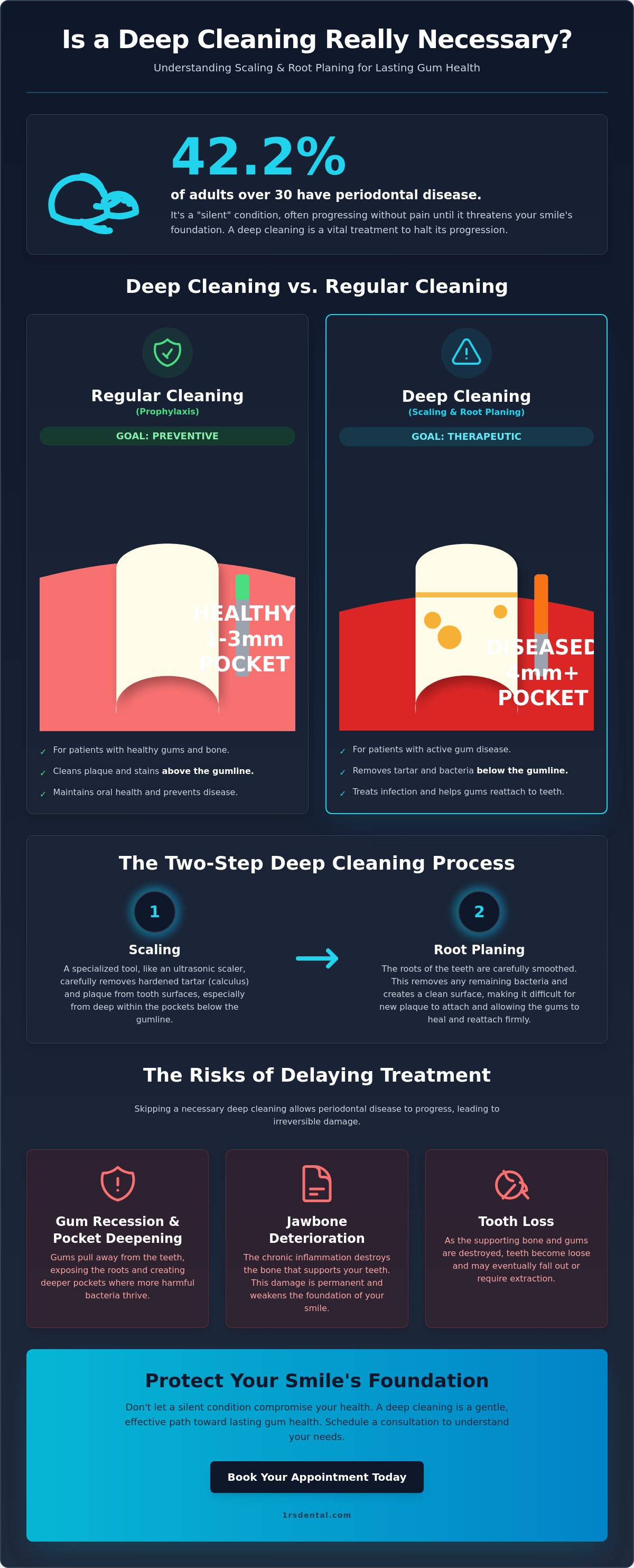
Did you know that 42.2% of adults over age 30 are currently living with some form of periodontal disease? It's a quiet condition that often goes unnoticed until it begins to threaten the foundation of your smile. When you're sitting in the dental chair and hear a recommendation for a deep cleaning, your first thought is likely a question: is scaling and root planing necessary? It's completely normal to feel a bit of hesitation or even worry about the potential discomfort and cost associated with a procedure that sounds more intense than a routine visit.
We understand that your dental health is a journey we take together, and we want you to feel like an empowered partner in every decision. You'll learn why this restorative treatment is a vital tool for stopping bone loss and how it differs from the preventive cleanings you're used to. This guide explores the details of periodontal scaling and root planing, showing you how it serves as a gentle, effective path toward lasting gum health and a confident, complete smile.
Key Takeaways
- Learn how a deep cleaning serves as a restorative treatment to heal your gums rather than just a standard preventive service.
- Understand the clinical indicators that help answer the question: is scaling and root planing necessary to stop the silent progression of periodontal disease?
- Discover how addressing deep bacterial pockets early protects your jawbone and helps you avoid the need for more invasive procedures.
- Explore the gentle methods and comfort options available to make your periodontal care a relaxed and positive journey.
- Find out how a personalized approach to dental health at U-First Dental Care in Rancho Cucamonga empowers you to make confident decisions for your smile.
Table of Contents
- Understanding Scaling and Root Planing: Why Your Dentist Recommends a Deep Cleaning
- Deep Cleaning vs. Regular Cleaning: Key Differences in Periodontal Maintenance
- The Risks of Delaying Treatment: What Happens if You Skip Scaling and Root Planing?
- What to Expect During and After Your Procedure: A Guide to Patient Comfort
- Choosing Periodontal Care in Rancho Cucamonga: The U-First Dental Care Experience
Understanding Scaling and Root Planing: Why Your Dentist Recommends a Deep Cleaning
Hearing that you need a "deep cleaning" can feel unexpected, especially if you aren't experiencing any pain. We understand that you might wonder, is scaling and root planing necessary if your teeth feel fine? Unlike a standard maintenance visit, Scaling and root planing is a therapeutic medical intervention. It's the gold-standard treatment recognized by the American Dental Association (ADA) for managing gum disease. While a regular cleaning focuses on the visible parts of your teeth, this procedure addresses the areas beneath the gumline where bacteria hide.
Gum disease is often called a "silent" condition because it rarely causes discomfort in its early stages. You might have healthy-looking teeth while the supporting structures are under stress. This happens when plaque, a sticky film of bacteria, hardens into tartar (calculus). Once tartar forms, it can't be brushed away at home. It acts like a wedge, pushing the gums away from the teeth and creating pockets where more bacteria thrive. This process eventually leads to gum recession and bone loss if left untreated.
The Clinical Definition of Scaling vs. Root Planing
This procedure involves two distinct steps that work together to restore your health. During the scaling phase, we carefully remove hardened tartar and plaque from the tooth surfaces and inside the deep pockets. The second phase, root planing, involves smoothing out the rough spots on the roots of your teeth. By creating a smooth surface, we make it much harder for bacteria to reattach and give your gums a clean environment to heal and firmly reconnect to the tooth.
When is Scaling and Root Planing Actually Necessary?
We determine the need for this treatment by measuring the "pockets" or spaces between your teeth and gums. In a healthy mouth, these pockets are typically 1 to 3 millimeters deep. When a pocket reaches 4 millimeters or deeper, it's a sign that the gum has detached and bacteria are accumulating where a toothbrush can't reach. At this stage, chronic periodontitis, a condition affecting nearly half of US adults, has likely begun.
You might notice subtle signs that your mouth needs extra care. Persistent bad breath that doesn't go away with mouthwash or gums that bleed during your routine dental check up and cleaning are common indicators. If we find these signs along with deeper pocket measurements, we'll discuss why is scaling and root planing necessary to protect your smile's longevity. We're here to help you understand every step of the process so you feel confident in your care plan.
Deep Cleaning vs. Regular Cleaning: Key Differences in Periodontal Maintenance
Understanding the difference between a standard visit and a deep cleaning helps you feel more in control of your dental journey. A regular cleaning, or prophylaxis, is essentially a preventative measure. It's designed for patients with healthy gum tissue and stable bone levels. In contrast, scaling and root planing is a curative medical intervention. When a patient asks, "is scaling and root planing necessary," the answer usually depends on whether we're maintaining existing health or treating an active infection that has moved into the deeper structures of the mouth.
The physical process and the tools we use differ significantly between these two services. During a routine cleaning, we focus on the surfaces of the teeth above the gumline. We use specialized hand instruments to remove plaque and polish away surface stains. For a deep cleaning, we often utilize advanced tools like ultrasonic scalers. These devices use high-frequency vibrations and a gentle cooling water spray to break up stubborn tartar deposits hidden deep within periodontal pockets. This thorough approach ensures that the roots of your teeth are clean and free of the bacterial biofilms that cause inflammation.
The Goal of Prophylaxis (Regular Cleaning)
The primary goal of a regular cleaning is to keep a healthy smile looking and feeling its best. We typically recommend these visits every six months for individuals with healthy gum measurements between 1 and 3 millimeters. It's a supportive service where we polish the enamel and remove early plaque buildup before it can harden into tartar. Think of it as a professional tune-up that preserves your oral health and prevents the onset of disease before it starts.
The Goal of Scaling and Root Planing (Deep Cleaning)
When bacteria migrate beneath the gumline, they reach areas where your toothbrush and floss simply cannot go. This is when we use scaling and root planing to treat gum disease and stop the cycle of bone loss. The objective shifts from prevention to active healing. By removing the source of the infection, we allow your body to begin repairing the delicate tissue around your teeth. After this initial treatment, we'll work with you on a periodontal maintenance plan to ensure the infection doesn't return.
If you haven't had a professional assessment in a while, it might be time to visit our team to ensure your gums are as healthy as they can be. Determining if is scaling and root planing necessary for your specific situation is a collaborative process that starts with a thorough, gentle exam. We're here to guide you through every step of your care with transparency and respect.
The Risks of Delaying Treatment: What Happens if You Skip Scaling and Root Planing?
It is natural to feel a bit of hesitation when a new treatment is recommended, especially if your teeth don't currently hurt. You might find yourself wondering if you can just wait and see if things improve on their own. However, gum disease is a progressive infection that does not resolve without professional intervention. Deciding if is scaling and root planing necessary for your health requires an understanding of what happens beneath the surface when bacteria are left undisturbed.
When bacteria settle deep into periodontal pockets, they create a destructive cycle. These pockets provide a dark, oxygen-poor environment where harmful microbes thrive. As the infection grows, your body's immune system tries to fight back, but the resulting inflammation causes the gums to pull even further away from the teeth. This creates even deeper pockets that trap more bacteria, leading to a continuous loop of damage. Beyond your mouth, this chronic inflammation has significant systemic links. Research has shown that untreated periodontal disease is associated with an increased risk of heart disease, diabetes, and other serious health conditions.
The Progression from Gingivitis to Periodontitis
Gingivitis is the earliest stage of gum disease and the only stage that is fully reversible. If the infection is allowed to progress into periodontitis, the damage becomes much more difficult to manage. At this stage, your immune system's attempt to clear the bacteria actually begins to break down the connective tissue and the jawbone that holds your teeth in place. It is a sobering reality that once bone is lost, it does not grow back naturally. Scaling and root planing is designed to stop this destruction before the foundation of your smile is permanently compromised.
The Final Stage: Tooth Mobility and Loss
When the bone and tissue supporting your teeth are significantly weakened, you may notice that your teeth begin to feel loose or "mobile." This is often the final sign of advanced periodontitis. At this point, the options for saving the tooth become much more complex and often more expensive. While we offer services like tooth extractions and dental implants, our primary goal is always to help you keep your natural teeth for as long as possible.
By choosing to move forward with treatment now, you are making a proactive investment in your long-term health. Consider the benefits of acting early:
- You protect the natural bone structure of your jaw.
- You reduce the risk of systemic health complications.
- You avoid the higher costs and recovery time associated with tooth replacement.
We are here to support you in making the best choice for your unique needs. Understanding why is scaling and root planing necessary is the first step in ensuring your smile remains healthy, strong, and beautiful for years to come.
What to Expect During and After Your Procedure: A Guide to Patient Comfort
The term "deep cleaning" often sounds more intimidating than the actual experience. We find that many patients feel a sudden sense of relief once they understand the steps we take to ensure their peace of mind. When we discuss why is scaling and root planing necessary for your health, we also focus on making the process as stress-free as possible. Typically, we treat the mouth in quadrants or halves. This methodical approach allows us to focus deeply on specific areas while ensuring you aren't in the chair for an overwhelming amount of time. It also means you'll have one side of your mouth fully functional for comfortable eating while the other side heals.
Ensuring a Pain-Free Experience
Our priority is your comfort and safety. We begin every procedure by applying a gentle topical numbing gel followed by local anesthesia. This ensures you feel absolutely nothing during the treatment itself. Dr. Velasquez is known for her gentle touch and her steady, calm communication rhythm. She'll guide you through each step, explaining what's happening so there are no surprises. We treat our Rancho Cucamonga neighbors like family; we don't rush the process. If you feel anxious, we'll take breaks and move at a pace that feels safe for you. Your autonomy and comfort are just as important as the clinical outcome.
Post-Treatment Care and Healing
It's normal to experience some minor sensitivity to cold or heat for a few days after your deep cleaning. This is actually a positive sign that your gums are beginning to heal and reattach to the clean tooth surfaces. You can manage this easily with warm saltwater rinses or a toothpaste designed for sensitive teeth. We'll provide you with a personalized home care plan to keep those bacterial hideouts from forming again. This usually involves specific flossing techniques or tools that reach slightly deeper than standard floss.
The most rewarding part of the process happens a few weeks later at your follow-up visit. This is when we measure your pocket depths again to see how much they've shrunk. Seeing those numbers decrease from a 5mm to a healthy 3mm is a moment of celebration for both of us. If you're ready to take this step toward a healthier smile, we invite you to schedule an appointment with our compassionate team today. We'll help you decide if is scaling and root planing necessary to protect your foundation and walk you through the process with the care you deserve.
Choosing Periodontal Care in Rancho Cucamonga: The U-First Dental Care Experience
At U-First Dental Care, we believe that your healthcare should be as unique as your smile. Dr. Magaly Velasquez has built her practice on a simple but profound philosophy: putting the patient's needs and comfort above all else. We understand that deciding is scaling and root planing necessary involves more than just a clinical diagnosis; it requires trust and clear communication. You aren't just another appointment on our schedule. You're a partner in your oral health journey, and we're here to provide the steady, expert guidance you need to feel confident in your treatment plan.
Our collaborative approach ensures that you never feel pressured. We take the time to show you your X-rays and explain the measurements of your gum pockets so you can see the state of your health for yourself. Once we've successfully completed your restorative care, we make the transition to long-term periodontal maintenance seamless. Our goal is to move you from treating an active infection back to a stable routine of cleanings that keep your smile bright for a lifetime.
Why Local Expertise Matters for Your Gums
Serving the Inland Empire community in Rancho Cucamonga, Alta Loma, and Ontario allows us to build lasting relationships with our neighbors. We understand the specific needs of our local families and offer the convenience of having both restorative periodontal care and routine cleanings under one roof. Our practice focuses on total transparency. We provide honest, no-pressure clinical advice so you can make informed choices about your longevity and health without the typical anxieties of a medical environment.
Your Next Steps Toward a Healthier Smile
Reclaiming your gum health starts with a simple, thorough assessment. When you're ready to find out if is scaling and root planing necessary for your specific situation, scheduling a consultation is easy. For your first periodontal assessment, it's helpful to bring a list of any medications you're taking and your previous dental records if you have them available. We'll perform a gentle exam and discuss our findings with you in a relaxed, friendly setting. We invite you to experience a different kind of dentistry where your comfort and health always come first.
Reclaiming Your Health and Your Smile
Choosing to address gum disease is a powerful step toward preserving your natural smile for the long term. By now, you understand that this treatment is a restorative medical intervention designed to stop the cycle of bone loss and protect your systemic health. It goes far beyond the surface of a routine visit to heal the foundation of your teeth. When you consider if is scaling and root planing necessary, remember that acting early is the most compassionate choice you can make for your future self.
Dr. Magaly Velasquez, DDS, and our dedicated team specialize in gentle, patient-centered restorative care for families throughout Rancho Cucamonga and the Inland Empire. We're committed to transparency and will always treat you with the respect and warmth you'd expect from a neighbor. Your comfort and autonomy are our highest priorities as we work together to restore your gum health in a calm and supportive environment.
Schedule your gentle periodontal evaluation with Dr. Velasquez today. We look forward to supporting you with a steady, methodical approach that puts your well-being first. You deserve a healthy, vibrant smile, and we're honored to help you achieve it.
Frequently Asked Questions
Is scaling and root planing painful?
Your comfort is our priority, and the procedure is typically not painful. We use local anesthesia to numb the treatment area, ensuring you feel relaxed throughout the entire appointment. While you might feel some light pressure as we work, you shouldn't experience any sharp discomfort. Afterward, some mild sensitivity is normal, but this usually subsides within a few days as your gums begin to heal.
How much does scaling and root planing cost in Rancho Cucamonga?
The cost of this treatment depends on the severity of the infection and how many quadrants of your mouth require care. Because every smile is unique, we provide a personalized estimate after a thorough examination of your gum health. We believe in transparency and will discuss all options with you before starting any procedure so you can make an informed choice for your health and budget.
Can I go back to work after a deep dental cleaning?
You can absolutely return to your normal routine, including work, immediately following your appointment. Some patients prefer to wait until the local anesthesia wears off to avoid accidentally biting their lip or cheek while talking or eating. While you might experience minor tenderness, it typically doesn't interfere with your daily responsibilities. We simply recommend avoiding very hot or crunchy foods for the first few hours.
What happens if I only get a regular cleaning instead of a deep cleaning?
A regular cleaning only addresses the area above the gumline, leaving the underlying infection untouched. If you skip the deep cleaning when it's needed, the bacteria will continue to destroy the bone and tissue supporting your teeth. This often leads to deeper pockets, persistent inflammation, and eventual tooth loss. Choosing the correct level of care is vital for stopping the progression of periodontal disease and protecting your smile.
How long does the scaling and root planing procedure take?
We typically schedule one to two hours for the procedure, depending on the complexity of your case. To ensure your comfort and prevent you from being in the chair too long, we often treat one half of the mouth at a time in two separate visits. This allows us to be thorough while giving you a break between sessions. We'll provide a clear timeline for your specific needs during your initial consultation.
How often will I need deep cleanings in the future?
Most patients only need the initial deep cleaning once to restore health to their gums. After the procedure, we'll transition you to a schedule of periodontal maintenance visits, usually every three to four months. These visits help us monitor your pocket depths and prevent the bacteria from returning. The goal is to move you toward a stable, healthy state where frequent deep interventions aren't required to maintain your smile.
Can scaling and root planing fix loose teeth?
This treatment can help stabilize teeth by reducing the inflammation that contributes to mobility. When the gums heal and tighten around the teeth, they often feel more secure in their foundation. However, since lost bone doesn't grow back naturally, the level of stability depends on how much support remains. We'll evaluate your specific situation to determine if is scaling and root planing necessary to save your natural teeth and prevent further damage.
Will my insurance cover scaling and root planing?
Most dental insurance plans provide coverage for this procedure because it's a medically necessary treatment for an active infection. Coverage levels vary between providers, often falling between 50% and 80% of the total cost. We recommend checking with your specific carrier to understand your benefits and out-of-pocket costs. Our team is happy to help you navigate your insurance details to ensure you receive the care you need without surprises.
Disclaimer
The content here is for informational purposes only and isn’t professional advice. Some links may be affiliate links, and we may earn a commission if you use them.